What I care about is helping people bring technology into their lives well — where it's genuinely needed, and where it can do the most good. Not tech for its own sake, not change to look modern. Sometimes that means AI; just as often it means something far simpler.The tech world is accelerating. This is my attempt to slow things down a little: to pick apart the hype and look for the reality and the truth in the messages — primarily around AI, and how it impacts us all.
An update on Signal Over Noise
Dear Reader, An update on Signal Over Noise. I'm approaching two years of writing Signal Over Noise. I never really wanted this newsletter to be another 'AI thing of the week' publication. There are loads of those going around, and mostly for good reason — there's a lot of stuff to learn and get through. But I started this as a 'building in public' kind of journal after the end of a years-long work contract that left me wondering what to do with myself. Since then I've learned so much. Those of you who have been with me from the beginning of my venture will know that things have shifted tonally and content-wise a few times before. I'm quite happy to own that; we can no longer afford to live in a world where information and presentation are static and don't adapt with the times. When I think about tech, and my place in it as a developer, educator and entrepreneur, what I really care about is helping people bring technology into their lives where it's genuinely needed, and where it can do the most good. Not chasing the latest shiny tech for its own sake, not just changing to look modern. The tech world is accelerating and lately feels like it's permanently on the cusp of hitting terminal velocity. Signal Over Noise is my attempt to slow things down a little: to pick apart the hype and look for the reality and the truth in the messages — primarily around AI, and how it impacts us all. But there's also a security element that I think gets overlooked and under-reported, particularly for non-technical audiences. To that end I've been thinking a lot in recent weeks, as we come up to the two-year anniversary of Signal Over Noise, about the direction I want to see it head in.
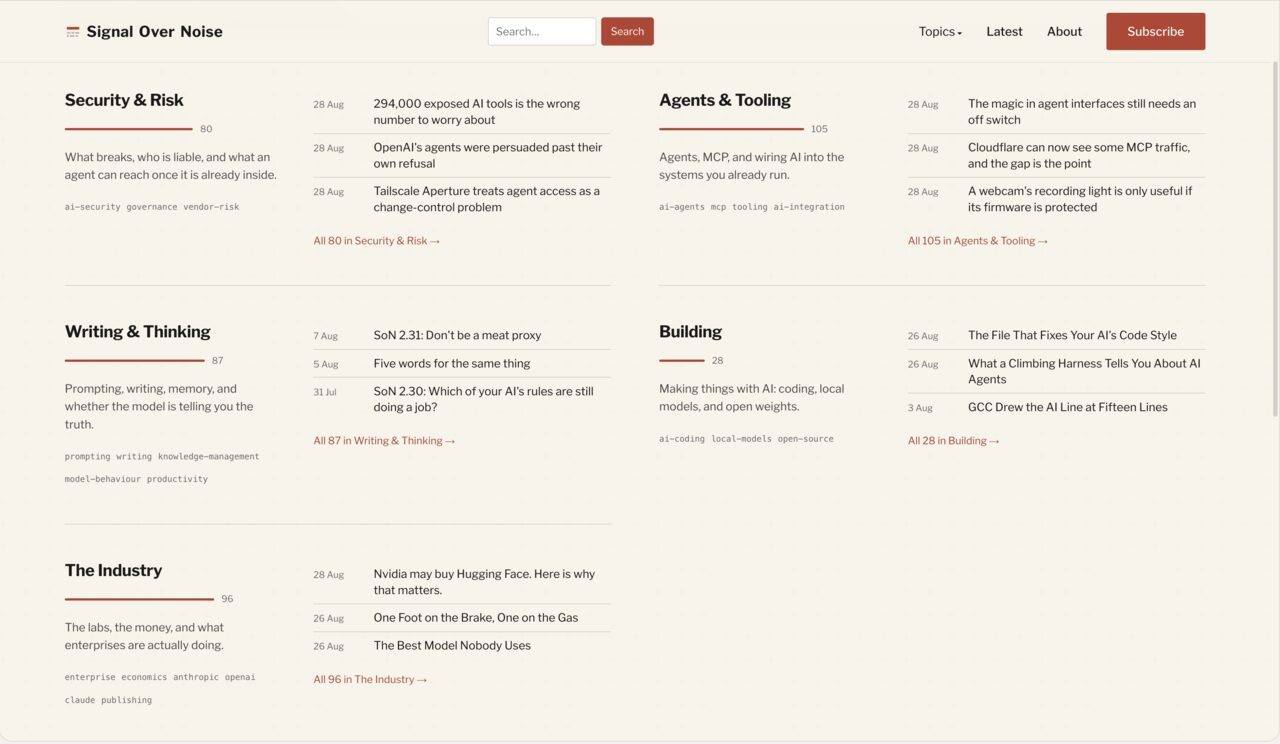
Signal Over Noise is becoming site-first — if you visit the site today at signalovernoise.at you'll see it's had a major facelift (and I'm still doing lots of tweaking) to cover the pillars I have an interest in:
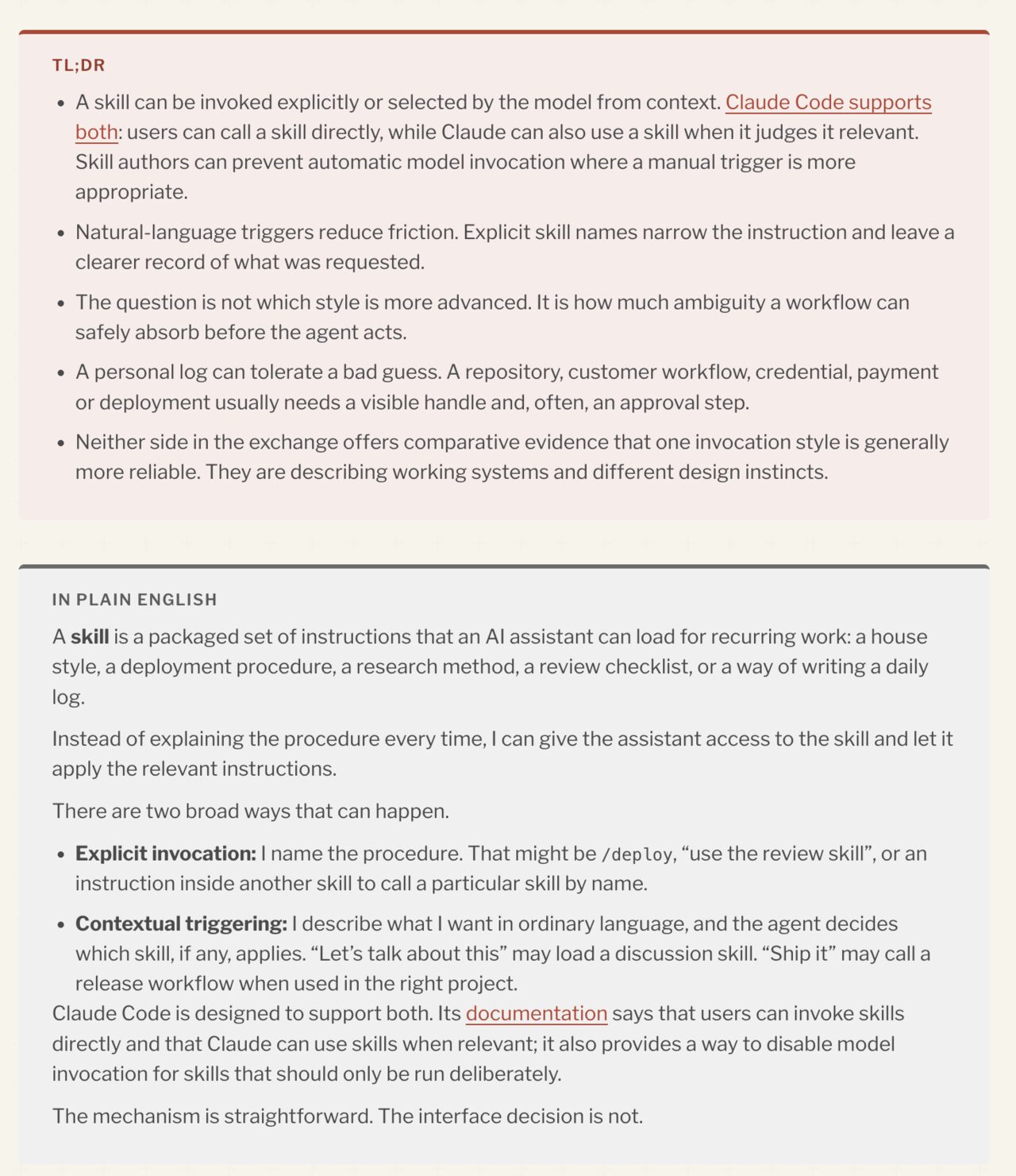
On top of that I'm making strides and a concerted effort to provide TL;DR and 'In Plain English' explainers on every one of my posts. I've put more glossary definitions in where there are terms and acronyms that aren't commonly known. I have aspirations about raising awareness not only of what technology can do, but of how well we understand it, and I don't want to see any of us left behind.
And because it's site-first, I'll also be adding a daily update that pulls directly from what I've written that day, rather than the "greatest hits" email at the end of the week or the 'Field Note'. My writing doesn't change — in fact, it becomes more focussed. I've done away with the freebie gimmicks, the paywalls, the walled gardens, the starter kits and the other things that people usually lean on to grow a list for the sake of growing it. I don't mind having a small list, if those people are engaged, interested and informed. I'd rather be a tech writer who influences than try to be a tech influencer who writes. Membership is still very much available to those of you who want to help cover the cost of the tools (including the mailing list!) that I use to write and to pass on what I learn. At 7 EUR a month, or 69 EUR a year, it gets you every issue without ads. Free members get exactly the same writing, with ads in it — that's the only difference between the two.
Some of you might just be interested in the "How do I do x with AI" posts, and I get that. I'm continuing Second Brain Chronicles over at Substack, and that will be focussed more on the builds of my AI agent system to support my ADHD brain. It's also free to join, with a community chat.
I think it's important to not become complacent about these things, and now, more than ever in an age of AI and automation, take the time to slow down, refine direction, and check that the thing in front of us is worth the attention it's asking for. Thanks for being a part of this journey with me. Jim |
Jim Christian - Signal Over Noise
What I care about is helping people bring technology into their lives well — where it's genuinely needed, and where it can do the most good. Not tech for its own sake, not change to look modern. Sometimes that means AI; just as often it means something far simpler.The tech world is accelerating. This is my attempt to slow things down a little: to pick apart the hype and look for the reality and the truth in the messages — primarily around AI, and how it impacts us all.
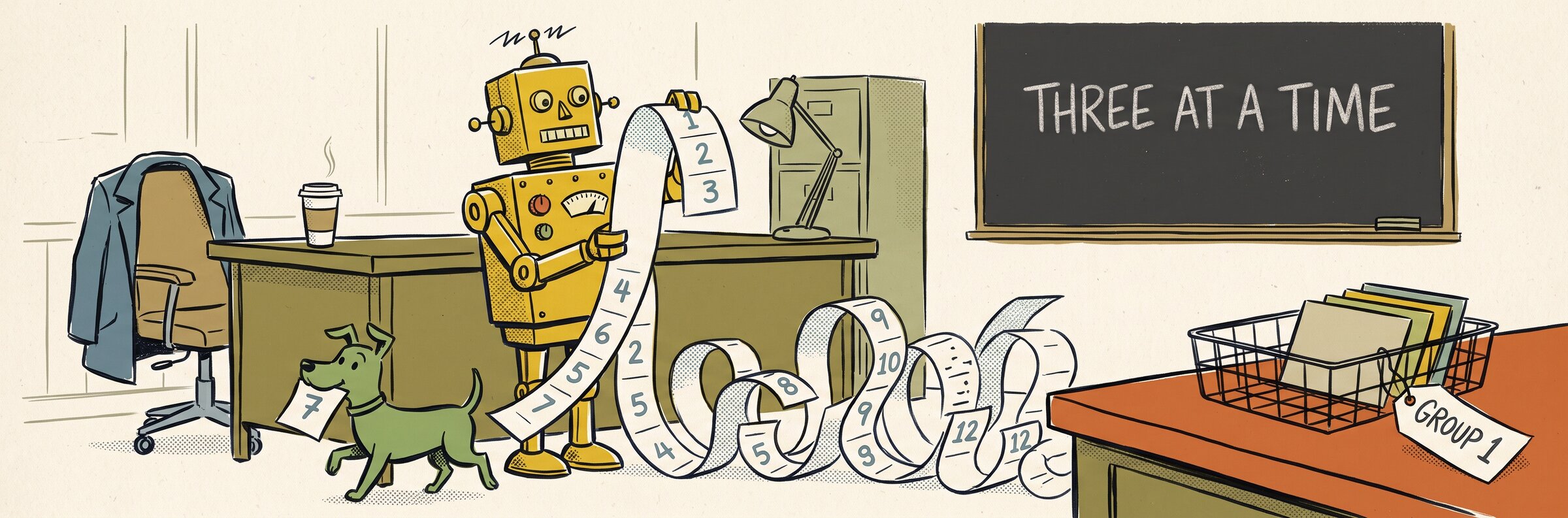
VOL 2, ISSUE 43 · NOVEMBER 2026 One of my favourite ways of working with AI is to set Claude or ChatGPT a task, or a series of them, before I go and do other jobs around the house. But often when I come back to it, it's waiting on me with a list of questions about details I don't remember discussing. I've spent the last hour on something else, and now it wants answers. I've often typed back something close to this: "These are too many questions. I'm a human. I can't deal with this much...
VOL 2, ISSUE 42 · NOVEMBER 2026 Frameworks are all around, and they've been in use for ages. Some of my favourites are the five whys, where you ask “why?” until you reach the cause of a problem, and the Eisenhower matrix, which sorts your tasks by how urgent and how important they are. There's no reason why you can't use these in your daily workflows to help you keep organised or to troubleshoot problems. If you don't know one for your job, ask your AI what established methods exist for it,...
VOL 2, ISSUE 41 · NOVEMBER 2026 Part of my daily routine has changed in the last week, in that I'm talking more with Claude in voice mode on my school runs in the mornings. It beats the repetition of listening to the radio station, and it gives me more space to ramble and go down the odd rabbit hole as I question the morning headlines and look for topics of interest. When I get on to something I like and want to follow up on, I ask Claude to make sure that it's saved as a Google Doc that I...