SoN Vol 2, Issue 10: Same Prompt, Different Model, Worse Results


Vol 2, Issue 10 | Mar 11 2026
Same. Prompt,Different Model, Worse Results

Dear Reader,

New LLM models drop every few weeks. Features change between updates. The prompting advice that was best practice six months ago has been revised — sometimes by the vendors themselves. And if you're like most people, the way you actually use AI today is basically the same as it was three months ago.

That's not a criticism by any means. AI moves fast enough that keeping your setup current is itself a recurring task — one that almost nobody schedules.

Last Saturday I made time for it. I went through every skill in my Claude Code configuration — documented procedures for repeatable work, things like running an editorial checklist, deploying a website, processing the morning email. I use this setup every day. I decided to see what still matched reality.

Aaaand....I found duplicates doing the same job. Skills that had grown bloated enough to need splitting into smaller, focused pieces. A whole cluster of related skills that collapsed into half their number once I looked at what they actually did. Legacy formats that hadn't kept pace with how the rest of the system had evolved. Files in the wrong place. etc. etc.

The worst finding was that the descriptions I'd written for each skill — the short summaries that help the system know when to use them — had drifted so far from reality that they weren't doing their job at all. The system was still finding the right tool most of the time, but through lucky guesswork rather than anything I'd designed. The descriptions were effectively decorative.

All in all it took about an hour and a half of passive maintenance while catching up on season 1 of 'Shrinking'. But all of that drift had accumulated in weeks, not years — on a system I use for hours every day.


What you're missing

This week's full issue digs into why your prompts don't travel between platforms — the structural differences between how Claude, ChatGPT, and Gemini process your instructions, the vendor guides that almost nobody reads, and a five-step checklist for auditing your own setup in twenty minutes.

This is what Signal Over Noise looks like from the paid side: tested patterns, honest assessments, and the implementation detail that makes the difference between reading about AI and actually using it well.

​Read the full issue — subscribe to Signal Over Noise →​

€7/month or €69/year. No sponsors, no affiliate deals — just honest, tested AI implementation work.


Until next time,

Jim


€7.00 / month

Signal Over Noise

Spend less time arguing with your AI.
Prompts, worksheets and starter files for using AI at work. Copy one into Claude,... Read more

​

Signal Over Noise is weekly, reader-first publication on AI "without the hype" published by Jim Christian. If you've been forwarded this issue, you can subscribe here: go.signalovernoise.at.

600 1st Ave, Ste 330 PMB 92768, Seattle, WA 98104-2246
​
Unsubscribe · Preferences​

Jim Christian - Signal Over Noise

Every week: one thing to try with AI at work this week, in plain English, with the prompt to copy. It works whether you use Claude, ChatGPT, Gemini or Copilot, and you don't need to be technical. I'm Jim Christian. I help people bring technology into their work where it's genuinely needed.

Read more from Jim Christian - Signal Over Noise
Three people at one long office table, each at a laptop: an older man in a wheelchair reading a page of numbered steps with pictures, a young woman with a hearing aid smiling at her screen, and a man in glasses ticking a short quiz, with a stack of dense

VOL 2, ISSUE 44 · NOVEMBER 2026 I think AI should be a common denominator for accessibility. It should be the place where anyone can stop, take a step back and say, right, I don't really get this. Break it down for me, show me something visual, give me an example. Claude, ChatGPT and Gemini will all build that for you, and you only have to ask once. I don't use these enough, but I need to. Save this line in your custom instructions: When I ask you to explain something, make it a step-by-step...
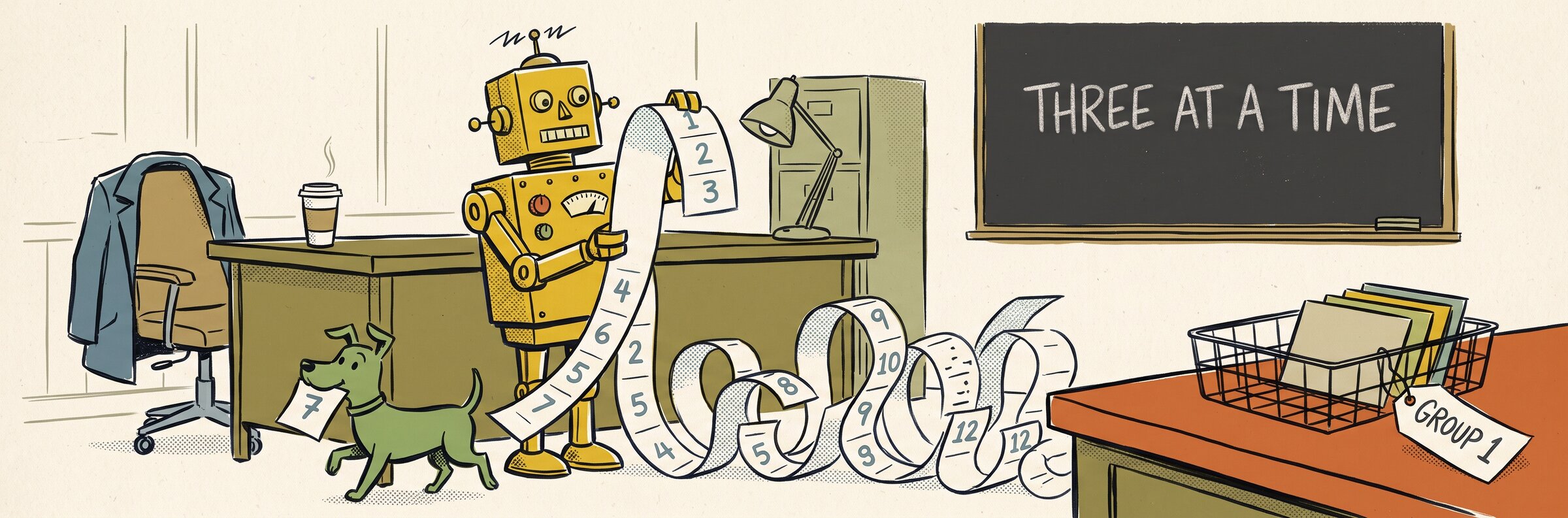
A yellow robot beside an empty desk chair holds up a long paper scroll of numbered question cards looping across the floor, while a green dog trots off with card 7; a tray tagged GROUP 1 sits under a chalkboard that reads THREE AT A TIME.

VOL 2, ISSUE 43 · NOVEMBER 2026 One of my favourite ways of working with AI is to set Claude or ChatGPT a task, or a series of them, before I go and do other jobs around the house. But often when I come back to it, it's waiting on me with a list of questions about details I don't remember discussing. I've spent the last hour on something else, and now it wants answers. I've often typed back something close to this: "These are too many questions. I'm a human. I can't deal with this much...
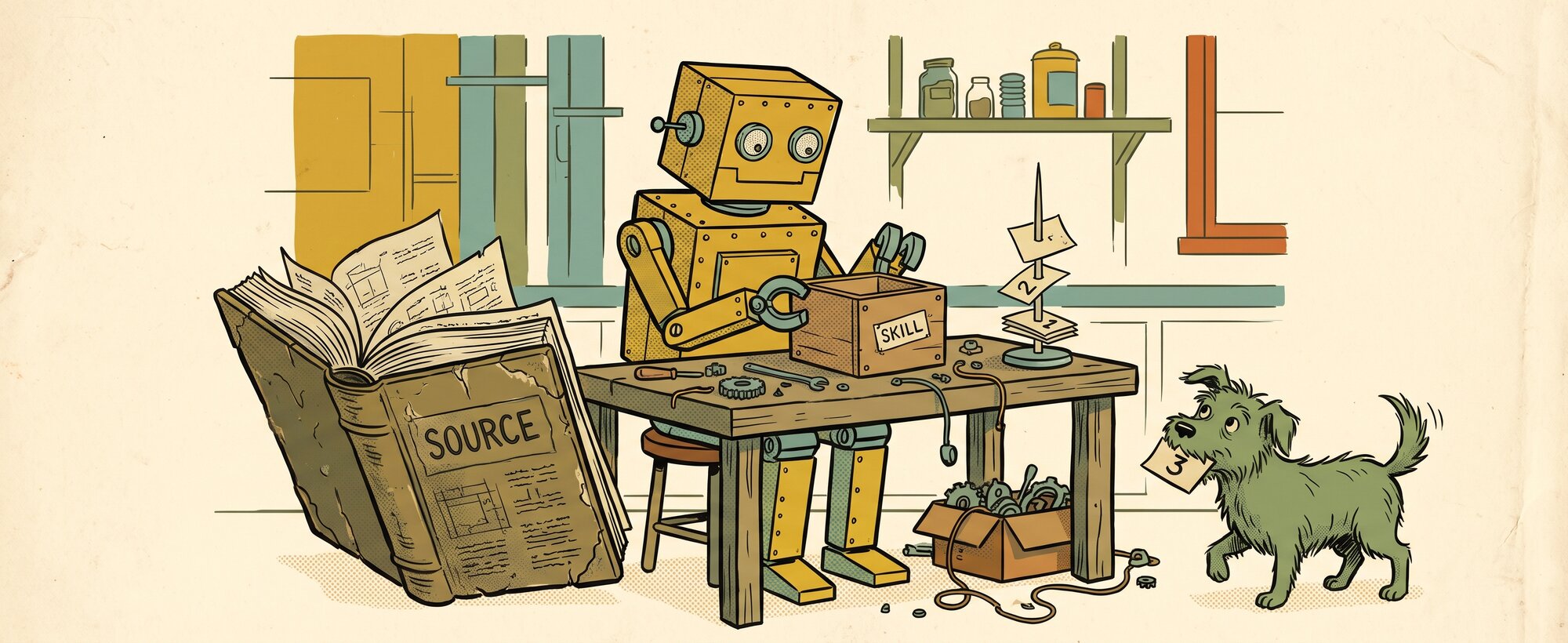
A boxy yellow robot at a wooden workbench assembles a small box labelled SKILL beside a large, worn book labelled SOURCE. Question cards numbered 1 and 2 sit on a spike on the bench, and a scruffy green dog walks up carrying card 3 in its mouth.

VOL 2, ISSUE 42 · NOVEMBER 2026 Frameworks are all around, and they've been in use for ages. Some of my favourites are the five whys, where you ask “why?” until you reach the cause of a problem, and the Eisenhower matrix, which sorts your tasks by how urgent and how important they are. There's no reason why you can't use these in your daily workflows to help you keep organised or to troubleshoot problems. If you don't know one for your job, ask your AI what established methods exist for it,...